
Tuesday, June 02, 2020
The American Spring
The American Spring, it sounds so weird, but I should not be surprised as I have always experienced a MASSIVE segregation in most of the American states I visited in the last fifteen years.
The most striking moment for me was when I visited Michigan in April 2007, invited by the US State Department. I was having dinner on my own in the restaurant of the hotel. There was a prom night going on, and I couldn’t believe my eyes when I saw solely black students sitting at one side of the venue and white students at the other side. Not one group of students was mixed.
The other moment I will never forget was when a Texan friend told me that until 1972, in Austin, blacks could not drink from the same fountains as whites. That information felt like a big punch in my face.
So yes, I totally understand the American Spring going on now but never thought that the USA would be the next country with anti-government protests, as we know happened earlier in the Middle East. I really hope someone will take sensible leadership to guide the American people (all colors!) through these hard times.
PS This photo is definitely going to be one of the nominations for the World Press Photo. The protester takes a knee in front of San Jose Police officers during a protest in California after the death of George Floyd in Minneapolis.


Thursday, January 17, 2013
London Calling
I only arrived yesterday (yes, the day that a helicopter crashed in Central London!), but it feels like I've been here for years! It's different to enter a city for business purposes or just for travel. I haven't seen much of London yet, and feel a bit guilty when I walk by the museums, churches, galleries and shops. But I just simply don't have time for that. Why am I here? To meet people! I probably scheduled too many meetings in a day, but it all works out well.
I want to start talking about three power ladies who all deserve a mentioning. Sandra Anido, general manager of a five-star Hilton Hotel The Bentley in the heart of Kensington. Sandra is Dutch and lives in London since 1998 as she fell in love with an Albanian boy and decided to stay. She started working as a receptionist of a hotel and now is general manager.
Then the Dutch-Turkish student Derya Yilmaz. We met through twitter, as she is a fan of Texas, she started following me on Twitter. Two years ago she studied International Business and Marketing in San Antonio, then returned to Holland but would do anything to get back to Texas. And in the meantime she decided to get her master's degree at a University in London.
Today I finally got to meet Meral Hussein Ece, whom I also met through Twitter. Baroness Hussein Ece is an English Liberal Democrat member of the House of Lords. She is the first woman of Turkish Cypriot origin to be a member of the house of Parliament. We met today at the House of Lords and discovered we have so many things to share: politics, biculturalism, women's rights, Turkey, Cyprus, Europe and of course motherhood. It's always wonderful to meet someone with whom you can talk in so many languages. A real power lady (and she has power too!)
Tomorrow hopefully I am going to meet Jennifer Howze. Jennifer is the co-founder of BritMums, Britain's largest and most influential parent blogging network. Previously, she was the online lifestyle editor at The Times, where she founded the newspaper’s Alpha Mummy blog. She also co-founded the CyberMummy conference, which debuted in July 2010 and ran for two years. In short, she is an entrepreneurial journalist, just like me :)
Tonight I am invited to a reception hosted by Member of the Parliament Nick De Bois in the House of Commons,an event organised by the Centre for Turkey Studies and the International Forum for Democracy and Peace (IFDP). The keynote speaker is Tuna Bekleviç, Founder and President of IFDP. The nice thing is that Tuna and I are both alumnis of the International Leadership Visitors Program. (The US State Department connects through IVLP current and emerging foreign leaders with their American counterparts through short-term programs).
I see that it's almost 6 pm, I am already running late.
So, no, except for the fact that I am sleeping in a hotel, I don't feel like a visitor at all! I am really looking forward to meet more active Londoners and internationalists!
Thursday, May 31, 2012
Atatürk's coup d'oeil
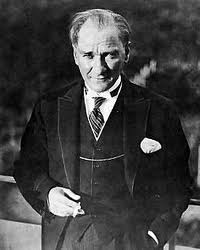
As a Kemalist myself, and following the recent developments in Turkey intensively, I am very curious what drove a retired US Colonel to write this book. Bay acknowledges Atatürk being a military genius. Atatürk's achievements have always been acknowledged. In 1997, Time Magazine called Atatürk Person of the Century and McLaughlin Group declared in 2000 that the award for "the Person of the Full Millenium goes to Mustafa Kemal Atatürk". I have read many books and articles saying Atatürk being a genius, both as a military leader but also as a statesman. But in Austin Bay's book I found what exactly is meant by genius, explained by Prussian general and strategic theorist Carl von Clausewitz.
By "genius" Clausewitz meant "a very highly developed mental aptitude for a particular occupation". Surveying "those gifts of mind and temperament that in combination bear on military activity," he emphasized that courage "in the face of personal danger, and courage to accept responsibility" are required. "The highest kind of courage is a compound" of "indifference to danger" and positive motives as ambition, patriotism, and enthusiasm." Clausewitz believed that war requires intellect of a special type, for "during an operation decisions have usually to be made of a special type, for "during an operation decisions have usually to be made at once; there may be no time to review a situation or even to think it through." For the combat leader, "if the mind is to emerge unscathed from this relentless struggle with the unforeseen, two qualities are indispensable: first, an intellect, that even in the darkest hour, retains some glimmerings of the inner light which leads to truth; and second, the courage to follow this faint light wherever it may lead.
The first of these qualities is described by the French term, coup d'oeil; the second is determination." Clausewitz's coup d'oeil referred to both the "physical" and "inward eye," but, "stripped of metaphor,...the concept merely refers to the quick recognition of a truth that the mind would ordinarily miss or would perceive only after long study and reflection."
In Clausewitz's other words: it really is the commander's coup d'œil, his ability to see simply, and at a glance, the possibilities offered by the terrain.

Thursday, March 29, 2012
A woman full of principles

I have a new hero! Tehmina Durrani.
The woman who took care of Fakhra Yunas, the Pakistani victim of an acid attack. Fakhra committed suicide a couple days ago. But Durrani arranged to take her abroad, capturing media attention for acid attacks in Pakistan.
Her own life story is amazing too. She grew up in a wealthy family, but after being used in her own marriage, she wrote about it, and questioned women's issues in Pakistan. Not by publishing her own book, but by funding an NGO for protection and care for other women in Pakistan. She distanced herself from everything to get rid of the manipulative patriarchal society, even signing for distance from her kids, to be able to do her work...
A woman full of principles...
Normally I don't post pictures on my blog but look at this beautiful picture of two women, how they support each other, probably knowing that it could have been either of them. It can happen to any of us. Maybe not the acid attacks, but all sorts of violence against women. It makes me hate societies in which these things happen. And I just can't understand how people, men or women, can sleep while this is happening.
Here is the link to Tehmina's full biography, I insist you read it.
Monday, March 12, 2012
Fighting basic women's health issues in 2012? Seriously?
What the heck is happening with this country?! Who knew that in 2012 in the USA politicians would be fighting about contraception and basic women's health?
Tomorrow I am attending a great idea from my friend Sarah Bird and Marcia Ball.
"COME and SEE RED"
It started last week, but tomorrow and following Tuesday, between noon and 2:00 PM, everybody is putting on a red shirt and stand in front of the Texas State Capitol at the corner of Congress Avenue and 11th Street holding a sign decrying the defunding of women’s health services.
The calling is named SEEING RED and it may be just a few women with a few friends or a few hundred.
No keynote speakers. No podium. No PA. Just red shirts and signs. Spread the word.
By the way, this is not a “women’s movement”, so come on, come all!
Sunday, January 22, 2012
Raped in time of war
As an alumni of the International Visitors Leadership Program (IVLP)
I was invited to a reception hosted by Global Austin for the IVLP's from Libya.
At this citizen diplomacy reception I met six distinguished visitors from Libya. These emerging leaders were selected by the U.S. State Department to visit communities in the U.S. for professional appointments and community hospitality. They are members of Libya’s National Development Board (EDB), assigned the task of creating a system to address the needs of veterans. The focus of their program is on the roles and responsibilities of governments, the private sector, and local communities that provide benefits and services to war victims and veterans.
Although almost all the six leaders (average age I guess not older than 30) could speak very well English, I was glad that they were hosted by professional interpreters. With such a heavy issue (victims of war) on the agenda, you better really understand what people are talking about and more important: what they need. As we all know, Libya just got rid of their dictator Khadaffi who ruled coldbloodedly over the country for 40 years. When I speak with these Libyan representatives, one thing is really obvious to me: they are young, ambitious but also 'seeking' their way how to develop their country.
The projectmanager of the Economic Development Board that I spoke a long time with, told me that more than 50,000 people got killed. Maybe that doesn't sound much (I mean in wartime), but Libya only counts a population of 6 million, so then it's a lot. What struck me most of his story was that next to the killings, more than 8,000 women were raped. For Libyans and most Arabs (but I think for many people around the world), this has had more impact than the killings. Khadaffi knew that Libyans could accept it easier to have their sons killed than their daughters raped. He used this psychological terror, and up until now, more than 8,000 women stay at homes, isolated, far from the society, and with no help. They are scarved for the rest of their lives.
When asked the delegation what they needed most, their answer was: support. Whether it's moral, mental, professional or financial, they said it's good to know that we don't have to do this alone. I was asked personally to keep on writing on Libya and the developments concerning the Arab revolution.
Well, that's the least I can do. In the meantime it is my intention to find out whether there is some kind of program being developed to help the 8,000 raped women. I will contact the Art of Living Foundation (a humanitarian NGO engaged in stressmanagement and service initiative) to ask whether they have already started a program in Libya.
Maybe you think: it all happens somewhere far, somewhere you don't know anything about, except for the images that you've seen on tv and read in newspapers). But I will never forget what my mother once said while we were watching disasters on the news: 'It's happening to them, but it could've been us.' When I look at it that way, I feel more connected to my Libyan sisters than ever.
Thursday, December 22, 2011
Rihanna slams Dutch magazine for using N-word
Published on New American Media on December 22, 2011
Before Tuesday, pop singer Rihanna’s millions of fans probably had never heard of a Dutch fashion magazine called Jackie. But a lot changed in 24 hours.
The fashion magazine, with a circulation of about 60,000, published a 100-word feature on page 45 about the singer’s good-girl-gone-bad style. The title? “De Niggabitch.” Within hours several things happened: Rihanna’s angry response went out publicly via Twitter, the magazine editor resigned, and the world got a good look at the Netherlands’ deterioration.
The incident stirred millions to ask, “Are the Dutch that racist?” Jackie’s editor Eva Hoeke, for her part, said it was a bad joke and apologized on Facebook. “It was naïve to think that this was an acceptable form of slang,” she wrote. “You hear it all the time on TV and radio, then your idea of what is normal apparently shifts—but it was especially misguided: there was no malice behind it.”
Malice? No. Ignorance? Undoubtedly. Dutch journalism in general is in a poor state. (In addition to the slurs in the title and text, the writer also called the Barbados-born singer Jamaican.) But it is also increasingly out of touch, a bastion of white Europeans covering a multicultural country. The large cities in the Netherlands are already more than half non-native Dutch, but you’d never know it from the media.
A journalist of Turkish decent who grew up in the Netherlands, I started researching the lack of diversity among the Dutch media 20 years ago, and even today many consulting firms make lots of money telling media companies how homogenous they are.
Eventually I founded a glossy magazine for young Mediterranean women, because they went completely ignored otherwise. At the same time, there is a certain arrogance to Dutch journalists; they just write any article as they see fit, taking little care toward their representation of other cultures.
The truth is that if the staff of Jackie included just one person of color, the editor would probably still have a job. Working in a multicultural environment—the real world, in other words—would have taught her not to use, let along publish, that type of language.
When the fast-and-furious reactions came flying at the magazine through social media, Hoeke claimed to be glad to be “engaging in a dialogue.” It’s a tired phrase. She might have gotten away with it if the brouhaha had stayed within Holland’s borders, where journalists successfully wrap their ignorance in the cloak of “free speech.”
But it was Rihanna who truly made this moment into a dialogue.
While much of the news coverage has focused on the singer’s F--- YOU!!! sign off, they skipped her compelling point: “Your magazine is a poor representation of the evolution of human rights! I find you disrespectful, and rather desperate!! ….There are 1000's of Dutch girls who would love to be recognized for their contributions to your country, you could have given them an article. Instead, u paid to print one degrading an entire race!”
I find her words deeply gratifying, all the more so because, in the age of Twitter, she could broadcast them so publicly. This way the whole world can assess what has happened to the Netherlands, once a cradle of tolerance, liberty and enlightenment. Imagine what the media looks like to the ethnically non-Dutch living in the Netherlands. There are nothing but blue-eyed blonds on the covers of magazines and catalogues. Same with the cast of the popular local version of ‘Jersey Shore,’ called ‘Oh Oh Cherso’. On the game show “I Love Holland,” host Linda de Mol quizzes guests about Dutch history and cultural trivia. Meanwhile, if there were elections now, Geert Wilders’ right-wing blatantly anti-immigrant party would be the second biggest party of the Netherlands.
Aided and abetted by its TV producers and magazine editors, the nation is retreating into a bubble that is offensive and outdated. And, as Rihanna proved, destined to blow up in their face.
Wednesday, November 30, 2011
A guide to Life
Wow, wow, wow, I came across this wonderful column from 1997, by a columnist, Mary Schmich, of the Chicago Tribune. She says everybody above 26 should try this:
A guide to life:
Enjoy the power and beauty of your youth. Oh, never mind. You will not understand the power and beauty of your youth until they've faded. But trust me, in 20 years, you'll look back at photos of yourself and recall in a way you can't grasp now how much possibility lay before you and how fabulous you really looked. You are not as fat as you imagine.
Don't worry about the future. Or worry, but know that worrying is as effective as trying to solve an algebra equation by chewing bubble gum. The real troubles in your life are apt to be things that never crossed your worried mind, the kind that blindside you at 4 p.m. on some idle Tuesday.
Do one thing every day that scares you.
Sing.
Don't be reckless with other people's hearts. Don't put up with people who are reckless with yours.
Floss.
Don't waste your time on jealousy. Sometimes you're ahead, sometimes you're behind. The race is long and, in the end, it's only with yourself.
Remember compliments you receive. Forget the insults. If you succeed in doing this, tell me how.
Keep your old love letters. Throw away your old bank statements.
Stretch.
Don't feel guilty if you don't know what you want to do with your life. The most interesting people I know didn't know at 22 what they wanted to do with their lives. Some of the most interesting 40-year-olds I know still don't.
Get plenty of calcium. Be kind to your knees. You'll miss them when they're gone.
Maybe you'll marry, maybe you won't. Maybe you'll have children, maybe you won't. Maybe you'll divorce at 40, maybe you'll dance the funky chicken on your 75th wedding anniversary. Whatever you do, don't congratulate yourself too much, or berate yourself either. Your choices are half chance. So are everybody else's.
Enjoy your body. Use it every way you can. Don't be afraid of it or of what other people think of it. It's the greatest instrument you'll ever own.
Dance, even if you have nowhere to do it but your living room.
Source: http://www.chicagotribune.com/news/columnists/chi-schmich-sunscreen-column,0,4054576.column
Monday, October 10, 2011
Stressed out
So, this is what they mean with women copying men's lives...as women get more financially independent, they also get more stressed... CNN came up with a list of the most stressed countries, at least for women, and India, the fastest growing global economy, topped the list: (The percentages indicate the percentage of women claiming to be stressed most of the time.)
1. India (87%)
2. Mexico (74%)
3. Russia (69%)
4. Brazil (67%)
5. Spain (66%)
6. France (65%)
7. South Africa (64%)
Italy (64%)
8. Nigeria (58%)
9. Turkey (56%)
10. U.K. (55%)
11. U.S.A. (53%)
12. Japan (52%)
Canada (52%)
Australia (52%)
13. China (51%)
14. Germany (47%)
15. Thailand (45%)
South Korea (45%)
16. Malaysia (44%)
Sweden (44%)
One good thing about the Indian woman being on the top of the list, is that she spends her hard earned money on herself; the Indian woman purchases beauty items and clothes. Which is excellent, because women, biologically speaking, tend to spend their time and money on family and household items. But taking care of yourself on the outside is still not sufficient to stay healthy (and succesful) in the long term. Maybe they should copy their Western sister's habits: women in developed countries spend their income on vacations, savings and paying off debts. By doing this, they get less stressed, physically and mentally, and prepare themselves, from the inside, for the next level of their life and career. This longterm thinking (which also most men do) can secure her more for a better, steadier and therefor healthier future, for herself and her family.
Source: http://newsfeed.time.com/2011/07/13/study-for-women-india-is-the-most-stressful-country-on-earth/#ixzz1aQE1i27L
Thursday, September 15, 2011
The Next 10 Years — Women Can Solve Immigrant Identity Crises
Published by Turkish Philanthropy Funds [http://tpfund.blogspot.com/]
I am a Turkish journalist. I am also Dutch and a Texan. I am a woman, a feminist, a mother, a lecturer, a soloist and a world traveller. I am also Muslim. Yet, since 9/11, my Muslim identity counted more than any other characteristic that has contributed to who I am today. Far worse is the western media’s attributes of the actions of very few Islamists to an otherwise peaceful faith with millions of followers. There is the common people’s religion and then there are the Islamists, the extremists who follow a violent ideology. In other words, not all Muslims are Islamists. My identity is far more complex to be defined by faith alone. I grew up in Europe with a strict secular upbringing and I find such homogenous branding of Muslims frustrating. Prejudices are for the lazy and for the intellectually weak. Why can’t Muslims experience religion as individuals?
Now that the media frenzy about the 10th anniversary of the September 11 attacks is over, what will the next 10 year bring? Will it be more of the same? How can positive change come about? Let me suggest one source of solutions as we begin a new decade—women.
The Muslim Smorgasbord
A few years back, as part of an international visitor’s program, I met with a fellow journalist in the United States. We ended up talking about motherhood, journalism, relationships and family ties, but nothing on religion. We had more in common than what separated us. The fact that she was a Christian and I was a Muslim had nothing to do with what we shared with one another. The same principle applies to the American identity. Americans are like a smorgasbord, the Swedish buffet which offers endless variety. They are liberals, they are conservatives, they are rich and they are poor. Not all of them are as conservative as Sarah Palin, or as liberal as Rachel Maddow, certainly not all are racists as the Klu Klux Klan. Neither are Muslims.
I am an optimist. Changes in Islam will come from Muslim women as they are endlessly being questioned about their religion. That’s why we have the urge to know more about our faith than most counterparts from other faiths. Such questioning is good for the entire community. What does one truly know about her religious and cultural identity? Does a Muslim woman have a religion of faith or has she adopted the family and national traditions as her own? Does she cling to the old ways and fight off any changes to customs as an infringement of her heritage? Does she find her new cultural surroundings uncomfortable or even irritating?
Women have been on the forefront of the protests in the Arab uprisings. They stood up for their rights; they ran equality campaigns, advocated multiculturalism and fought the extremists. Women have been the first victims of extremism, and that’s why they are desperate to make changes. It needs not to be the western way, but our way, and of our own making.
Women, Sex and Stereotypes
Due to easy access to information on Internet, Muslim women know they have rights. They are more educated and more women are literate. They do not accept inequality anymore, which is why they talk, discuss and write about delicate issues. I wrote about women and sex in my first book The Wax Club, as did many other Muslim authors.
The North African author Nedjma proved in her erotica novel Wild Fig that Muslim women can write about sex. When asked why she has chosen that topic, she said: It all happened after 9/11. I wanted to break down the negative image of Arabic women by writing about love and erotica. By showing that not all Arabic women are veiled and by explaining that the Western perspective is too much one-sided. And I wanted to shock the Arab man with a story about female sexuality. In the Maghreb sex is a taboo; you don’t talk about it, let alone write about it. Wild Fig is my protest against both parties.
My hope is that more Muslim women and the next generation of Muslim women will see their faith as means to a new way of life, one that is ready to tackle the difficulties of the twenty first century. As the famous scholar Akbar S. Ahmed said: “We should not approach Islam as an exotic and different world. It shouldn’t be the Islam versus the West, it should be Islam in the West.”
Monday, August 22, 2011
Slipping through my fingers
There it was. Hakan's first school day at the middle school.
Today another new era begins. Don't know what happened; I still clearly remember his first day at the Kindergarden, then the elementary school, Oh My God, it all went so fast.
Like I said, don't know how 8 years went by.. but the following song exactly tells how I feel today (with a little changes that I made because it's a boy). One tip for moms with middle schoolers: Get tissues, because I don't think you'll end reading this without crying):
Schoolbag in hand, he leaves home in the early morning
Waving goodbye with an absent-minded smile
I watch him go with a surge of that well known sadness
And I have to sit down for a while
The feeling that I'm losing him forever
And without really entering his world
I'm glad whenever I can share his laughter
That funny little boy
Slipping through my fingers all the time
I try to capture every minute
The feeling in it
Slipping through my fingers all the time
Do I really see what's in his mind
Each time I think I'm close to knowing
He keeps on growing
Slipping through my fingers all the time
Sleep in our eyes
Him and me at the breakfast table
Barely awake
I let precious time go by
Then when he's gone
There's that odd melancholyc feeling
I try to capture every minute
The feeling in it
Sometimes I wish that I could freeze the picture
and save it from the funny tricks of time
Schoolbag in hand
He leaves home in the early morning
Waving goodbye with an absent-minded smile
(Bjorn Ulvaeus/Benny Andersson)
Wednesday, June 01, 2011
Alliance Francaise
My son and I are getting ready for our big move to Texas. While cleaning the house and packing some closets with books and old magazines, I found an interesting piece in an old newspaper that I obviously have kept for some decades. It dates May 1986. And it's an article about me winning a prize for the best French essay, organized by the prestigious institute Alliance Francaise. I never intended to participate to the Contest but my French teacher, Mrs. Staal, insisted, and I won! More than 1400 students from Holland participated and thousands of others from all over Europe. I remember some details about the essay but I definitely have to make sure that I find it...It should be somewhere..
This winning essay shows my passion and probably can be seen as the start of my writing career! But there is another thing which is so much more important here. What happened back then also says something about a good teacher. Actually my teacher, Mrs. Staal believed in me and discovered my talent. She persuaded and signed me in when I had not enough self esteem to put up my finger when she asked the class who wanted to face the challenge of writing an essay in French. She looked at me right away and was surprised that I kept quiet. Yes, I loved studying and talking French, but never thought I could write essays. Then she said: "Well, Senay, I think you can do this easily so I am signing you in."
I was one of her best students (in French) but Mrs. Staal saw also another talent in me. She pushed me in the right direction and ever since, when I write, I think about her. For me, Mrs. Staal has become more than a teacher in French language. She is one of the people who gave direction to the life I'm living now.
Great teachers who recognize talent in students are priceless!
Wednesday, March 09, 2011
Vyjanthi and the princess of Oman
Yesterday, the whole world celebrated International Women's Day. It sounds rather ridiculous to celebrate a day especially for women but as long as it's necessary we will do that. According to a survey of the Virginia Commonwealth University it will take 580 years before there is gender equality in top managerial positions. Yes, we have a long way to go... Not in executive and leading positions but in almost every level.
Yesterday, I watched a very sad documentary 'No country for young girls?' about a young Indian woman who has to choose - stay with a husband who doesn't want female children, or make it on her own?
Twenty-seven year old Vyjanthi, already mother to one 3-year old girl, was forced by her husband and in-laws to have a scan to determine the sex of the foetus, when she became pregnant again. Told she was carrying a girl, they tried to pressure her to have an abortion, and after a major argument she fled to her parents' home. But she felt bad, went back to her husband, got pregnant again, and the same thing happened all over again.
Now she's living with her parents, with two young daughters - and undecided whether she can make it on her own, or will have to go back to her husband again. Sex-selective abortion is illegal in India, but so widespread that there are many more boys than girls, especially in India's more prosperous states. Vyjanthi wants to know if things are really as bad for girls in the rest of India as in her own neighborhood. Isn't India now one of the world's booming economies, thanks to its embrace of globalization?
Life takes Vyjanthi on a journey through India, and films as she makes a disturbing discovery. Just because a country's becoming richer, doesn't actually mean life's going to be better for most people. In fact the status of women in India is falling behind that of women in many other countries, even in South Asia, and the newly prosperous middle class are particularly likely to abort female foetuses.
Will Vyjanthi decide that India can offer her and her daughters a fair and prosperous future on their own? Or will she decide that India is no country for young girls, and go back to her husband?
Heartbreaking documentary, but very inspiring to see that women are 'searching' for what they want for themselves. Vyjanti was my hero.
Vyjanthi's journey ended in Bangalore, the place where I have met another, of a very different level, woman a couple of years ago, the Omani princess Susan al Said. She is an empowering woman who fights for women's rights in Oman. American by birth, Omanese and muslim by marriage, she also owns a galery in Muscat. We had a nice and long chat after her speech at this woman's conference in Bangalore. She was very curious about my magazine and took with her three copies of SEN, folded in a veil, because it contented 'obscene' images (according to Omanese Arab standards). She said it could take decades before something like SEN could be possible in her country; if ever possible.
Vyjanthi and princess Susan, both so different women with a totally different background, and yet so close to each other, both trying to balance out stereotypes. That's so inspiring! I wish everybody a happy International Women's Day!
Saturday, February 19, 2011
Literature and Islamophobia
I have been invited to speak at the LSE ‘Space for Thought’ Literary Festival on Literature and Islamophobia.
The event will be held at LSE (London School of Economics) today (19th Feb from 630pm to 8pm). The panel will also feature one Dutch Muslim writer Naema Tahir and a British Muslim writer Shelina Zahra Janmohamed. We will all comment on the subject - Literature and Islamophobia - from our perspectives of multicultural origin based in writers.
This was the blurb about the event:
There are few places in Europe in which the voices of multiculturalism and Islamophobia have clashed more forcefully than in the Netherlands, often in the most dramatic ways. To name just a few, Pim Fortuyn, Theo Van Gogh, Ayaan Hirsi Ali and most recently Geert Wilders have been very much in the international press over the last decade. In the UK we are now 14 years on from the publication of the influential Runnymede Trust report Islamophobia: a Challenge for us All which sets out an agenda for overcoming social exclusion of British Muslims. Fiction writers from Muslim backgrounds have played an important role in the debate about multiculturalism and Islamophobia. We will explore how they see their art as a tool to facilitate cross-cultural dialogue and political discourse about integration.
Our panel consists of Şenay Özdemir and Naema Tahir, two women Muslim writers from the Netherlands, and Shelina Zahra Janmohamed, a woman Muslim writer from North London, who will talk about what motivates their art as women Muslim writers in respectively the Netherlands and the UK.
I am looking forward to it, as I really don't know how this topic is being discussed in Great Britain. I don't know what to expect; on one hand I think the debate must be the same (as British PM Cameron functioning as a parrot to what Angela Merkel and Geert Wilders have said about 'the multicultural society' having failed), on the other hand I expect that the British muslim society reacts on islamophobia very differently as they have been in Britain for a longer time and are higher
educated (on average) than Dutch muslims.
We'll see..I'm definitely going to listen what Naema and Shelina have to say, and of course looking forward to the questions of the audience. Because that tells so much more than anything.. What do people want to know? What are they looking for? And who are they? I'll hopefully let you know soon...Now, I have to get ready and do some homework before calling a London taxi! Ciao!
Friday, February 11, 2011
10 Tips To Becoming Fearless In Love, Work & Life
I had bought her book at BookPeople just after I had had my first class at the School for Journalism. I had asked my students to give a list of the Top 5 news Web Sites they visited every day. One of them was The Huffington Post. Until then, I had never heard of this site (I'm still ashamed of that, but please understand that Huffpost is still not very popular in Europe). But after my students stories about Huffington, I became so curious about this woman that I went to the bookstore to get her books. I bought On Becoming Fearless..In Love, Work and Life.
It's a wonderful, empowering and very well written book that every ambitious woman should read.
I want to share Arianna Huffington’s Top 10 Tips to becoming fearless:
1. Be true to yourself. Constantly looking over your shoulder for approval means you’ll never find it. What’s more, you greatly increase your chances of walking into a wall or falling into a ditch – not to mention losing yourself in the process.
2. Turn down the volume of your inner critic. Everyone has one: the obnoxious roommate in your head, always there with the critical, selfdoubting comment. But that doesn’t mean you have to listen. When the negative judgments start to blare, hit the off switch or drown them out with your iPod.
3. Look past the glass ceiling to endless opportunity. Preoccupation with impediments allows us to climb only so high. Keep your mind open to new adventures and you’ll surpass every expectation.
4. Use the mirror to make sure your lipstick isn’t smudged, not to judge your value as a person.
5. Stop comparing yourself to others – it’s a no-win game. And especially comparing yourself to supermodels, who don’t even look like the perfectly lit and airbrushed supermodels we usually see in magazines.
6. Get enough sleep. It’s next to impossible to be fearless – or to be your best self – if you are sleep deprived. A good pillow is a vital addition to any beauty regime.
7. Slip to an air of self-assurance. Fearlessness is sexy. So is confidence.
8. Run, swim, bike, hike, do yoga, or hit the gym. And fill your lungs with fresh air. Never forget – you can go weeks without food, days without water, but only mere minutes without breathing.
9. Be assertive in love. Know what you want out of a relationship and have the courage to express yourself to get it. And if you don’t get it – and if the other person can’t even handle the mere expression of your needs – be strong enough to walk away.
10. Always remember: True fearlessness comes from a deep and complete acceptance of ourselves – not from what we wear, or how we look or what we do, or what we accomplish.
I am working on points 1, 2, 4, 5 and sometimes 9. I wish myself and all of you who want to become fearless good luck!
Monday, February 07, 2011
Arianna Huffington
I realized how encouraged I was the moment I heard the news about AOL merging with the Huffington Post. If there is one woman who inspires me at this moment, then it’s Huffpost’s founder and editor-in-chief Arianna Huffington.
She is a fascinating woman. As the author of the book ‘On Becoming Fearless ... in Love, Work and Life.’ she already has illustrated multiple times to be fearless. The first time was when she left Athens, Greece, where she was born, to go to England in order to study at the Cambridge University. Many people want to study internationally, but let’s face it, there are still far too few women who take up that challenge.
The second time she was fearless was when she left her then-boyfriend, the famous Times-journalist, Bernard Levin. She broke off the relationship and moved to the United States, because of Levin's refusal to get married. I feel pretty certain that Arianna NOW thinks it was probably the best thing she did back then by leaving him, but we women know how difficult it is to end a relationship, and certainly with someone you say was the love of your life.
The third time she showed her fearless power- no, that was not the time when she married a millionaire- was when she found Huffington Post and made it the most successful blogging-site in the world, and became a millionaire herself. Maybe the men in her life partially contributed to her success, - of course everything and everybody in her life probably influenced her decisions on some levels - but it always makes me happy when women rise up, and show leadership by really changing the concept of the news industry. My fascination is more as I also created a different model in the media: a magazine for Mediterranean women.
As Forbes ranked Arianna one of the 12th most influential women in the media, she is a role model for we women journalists, and for women in general, to be fearless and really go for our dreams. She has defined how she can be a leader, and not be let a man or a past career move keep her from reaching her goals. It is inspiring to read stories about women who not only SAY what they want to do, but to act and actually DO those dreams.
I remember her saying in one of the interviews about her book - on how you become your own leader - by looking in the mirror, and you should stop searching for the knight on the white horse who is going to “save” you; And she is right, that only results in your being disappointed again and again.
Her life is the best example for the power of a woman. She divorced from a wealthy man (after he made it clear that he was more attracted to his own sex), she became an influential and wealthy woman in her own right. Her looks and name may mislead you, with her sexy business suits, blond hair and “enhanced” face; she looks like a typical American businesswoman. But then you discover she is not American at all, but conquered America, she becomes a role model for every one of us in the world.
I hope the story of Arianna will inspire more women to pursue their goals, and to become their own leaders.
Wednesday, February 02, 2011
Daddy's great ambition
It's funny how things can turn so surprising and strange in your life. In 2009 I taught a class at the School for Journalism consisting of very ambitious and hard-working students. I would have never thought that I would become a teacher, even though my entire family consists of teachers: my father and all my uncles were lecturers and also my eldest sister has been teaching very small children for more than twenty years at a Dutch elementary school.
I remember that my father, who passed away exactly seven years ago, was very passionate about his work. With his good looking (he had amazing brown-green eyes), but authoritarian appearance and his knowledge, he gained respect from his students, their parents and the whole community. Whenever we met people in town, or at parties, people would say 'She is the teacher's daughter'. Which was not always fun, because we had no names! We were always 'the daughters of...'. Not that we were not proud of our dad but it also meant that we had to be better, smarter and always more proper than anyone else. If I got a B on my report, my father would ask why it wasn't an A. He did the same with his students as they were also my friends. When I grew older, I asked my father why he did that. His answer: 'Who else could have taught you to be ambitious?'.
Back then, it was no fun. But now, I am very proud that I experienced schooling and being pushed the way I was. But I also realize, after teaching at the University of Texas, how difficult it was for my father to be like that. Expecting the best out of his students meant also that he was highdemanding of himself. His students were ambitious because he was. His children were ambitious because he was.
I experienced how difficult and challenging teaching is. That it's not only about giving the facts and explaining how things work, it's also about stimulating, motivating and inspiring the students. Maybe I can never be as good as my father was, but at least I inherited something from him. I became a mentor. After ten years since my first column was published, I still get questions from my (female) readers, because I have always kept in touch with them. Some of my former UT-students still contact me and my former employees of SEN regularly email me for career-advise. The experience that my little nieces and nephews ask me to help them with their essays and presentations makes me happy. My goal? Inspire them to aim for the highest. And of course, above all, I hope that I can be a rolemodel for my own son.
I may not have my dad's brown-green eyes, but without his great ambition I know I could have never come so far.
Tuesday, December 14, 2010
Nil Rocks!
What I like most about her? Every song describes in detail one aspect of life, love or marriage.
It’s not just a cliche of ‘I love you.. why don’t you come back..’ or ‘Never intended to hurt you..sorry..please stay with me.’ No, Nil Karaibrahimgil writes about how much she – like every girl on this planet - once desired to wear a pink princess dress. At the concert she gave in Paradiso Amsterdam, she started with an excuse telling why she (thought)?) looked weird, with a lace princess skirt on leather brown pants. Every other singer might look ridiculous, But not Nil. Nil Karaibrahimgil, singer, songwriter, cum laude graduate in politics and international relations looks like a supermodel.
Before I had even seen her, I already was fan of her voice. She sang the original soundtrack of the movie ‘Organize Isler Bunlar’ and her distinctive voice using a certain girlish accent, made me curious of who the singer was of this beautiful maffia-song, and what was her story?
I got the chance to interview Nil Karaibrahimgil- known in Europe as the Turkish Bjork, because of her extravagant and daring outfits- quickly after the concert, just for ten minutes- but enough to ask her some nice questions. What I found out:
It was her first time in The Netherlands, but she liked being in Amsterdam a lot. She particularly was fascinated by Paradiso; and that shows her good taste because the authentic building is definitely one of the finest concert locations of this country. Many pop singers would like to stand on the main podium of Paradiso. Nil said she was determined to come back soon and make a bigger tour around Belgium and Germany, because Turkish singers are not used to do European tours as often as other singers do.
Nil is a versatile woman. One of her songs ‘Sana kek yaptim’ (translated: I made cake for you), made me question if she bakes cakes for her partner. She surprised me when she told me she doesn't even bake cakes. Yes, she is definitely 'a free girl', named after her song 'I am free', which is about liberation and feminism.
That’s what I like about her songs. Most of them are about strong women who can take care very well for themselves. Her song 'Pirlanta' (Diamond) is one of my favorites. In this song she tells that she bought her own diamond ring. She seizes topics out of the daily life of contemporary women. One song is totally written about sleeping on your own in a King size bed. She surprised the audience when she asked;’Who in this room sleeps alone in a King size bed?’ Most people (men and women) raised their hands wistfully. And then she said: ’Well, it’s easily fixed. Date with each other!!’
Sometimes her songs are more political, such as "Yaş 18" (Age 18) which is one of the two tracks she recorded for the soundtrack of the Turkish movie Sinav (Exam). The movie and the song deal with the pressure Turkish students face during adolescence.
My last question - about her future plans - actually surprised me, but I should've known better. Her dreams don't differ much from the girl next door's: Now that she's married (at the Nile in Egypt where her name comes from), Nil desperately wants to become a mom. Like most girls do.
Saturday, December 04, 2010
Hymen Reconstructions
Recently I tweeted Sadie Stein's article about women restoring their virginity. To me, this topic is not new, since as an editor of a woman's magazine we have been dealing with it for a couple of years already. I have received a lot of questions about how women know if they still have a hymen. We wrote columns and articles about it, like the virginity test (in Dutch), and my one page op-ed about the virginity-paradox, published in the Dutch daily NRC Handelsblad, received many reactions from all around the world.
I get outraged about this topic, each and every time. Why would a woman be judged by this itsy bitsy mini tiny thing in her body for ALL her life? What's important is that you and your partner/husband shouldn't care. And do you think virginity is a romantic thing? Come on! I get more frustrated when I hear about women who '’keep these traditions’'. What kind of woman are you when your annual gift to your husband is having your hymen restored so that you can be a virgin at least once a year? I get mad when I hear replies of dudes saying "I rather marry a virgin because sex with me is the only sex she has to know." I know, from the letters to my magazine that there are, luckily, also men saying: "I'd rather marry someone with experience because then I know I'm the best she's ever had." And I love this reply of an Arab girl to Sadie's article: "Guys who just look harder for girls who ARE virgins? Well then they can go fuck themselves because I don't want to."
And yes, this is all about the patriarchal world we are living in. According to many many tribes and religions, women are just not supposed to enjoy their body, or enjoy their life.
But we can make this stop and wash out the myth. First, hymens do not break, nor do they disappear after first vaginal intercourse. So, the expectation that a woman bleeds on her wedding night is out of keeping with the reality of many women's bodies. Because, most women (more than 50%) do not bleed their first time. In most cases the hymen is a small band on the side of the vagina (1,5 centimeters down the vagina). This band is very flexible. Not everybody has this band and it disappears by aging. Because women are all different, even a doctor can hardly tell by looking at a vagina whether a woman has had children or if she ever had sex. In rare cases there is a string in the middle. In one of a million times the vagina is closed of by the hymen. This causes problems because menstruation blood can not leave the body. If this is the case, a doctor needs to open the hymen.
But I have hope when I hear women liberating themselves. So, I want to finish this post with one fantastic and hopeful reader's comment to Sadie's article: "Why would I want to restore my virginity? It took me forever to finally get rid of it."
Sunday, October 31, 2010
Two fingers
I was speechless. In fact, I still am. Did you hear about the Indian finger test? Well, hold on, it's horrifying and it really is as awful as it sounds. What is it? The finger test is a rape test used by doctors to determine if sexual intercourse is being practiced. The doctor inserts two fingers into a rape victim's vagina to verify the presence or absence of the hymen.
So, let's rewind.
It won't be easy, but try to imagine you have just been raped— already an awful experience to deal with. Terrified your family will condemn you, you go to the police. The police say they are not convinced about your statement or story. Neither does your family. They want to know whether you were raped because you 'asked for it', or you were 'chaste' enough and truly a victim of rape. To determine the validity of your story, they send you to the doctor. While you are still enduring the mental and physical anguish and humiliation of the rape, you have to take a seat in the gynaecologist chair and let a strange man, a doctor, insert two fingers in your vagina to check the 'purity' of your most intimate female part.
The results are only multiple choice: it can be "two fingers admitted”, “two fingers easily admitted”, or “two fingers not easily admitted". These results can be understood as "used to" or "not used to" sexual intercourse. Of course, the two fingers represent the thickness of the penis.
I don't know about you, but when I read about this I couldn't believe my eyes. It is outrageous and unacceptable. This 'examination' simply can't be medically accurate for several reasons:
1. There is no such thing as a hymen;
2. Each and every woman's vagaina is built different;
3. Each and every man is built differently too: small penises, long ones, thick, thin and so on and so forth.
So for an Indian girl, it's all about luck. Judgement is determined by the insertion of two fingers by a man (suppose female fingers are thinner) in the most intimate part of her body, which will judge her for the rest of her life. Where is this going?
Well, I am elated to know the Human Rights Watch is calling for a ban; and a lower court recently ruled this rape test should be stopped. But although the Indian government prohibits the test because of its immoral nature and some hospitals have banned the test, the doctors and, more importantly, the people in India still see value in it.
Which is where we end up once again in the never-ending circle in patriarchal societies. No one wants to deal with women complaining of sexual harassment. Instead of acknowledging it is happening, and educating doctors on how to deal with this huge issue, or offer women support, women, again, end up being a victim for the second time.
Now, tell me, if you were an Indian woman, would you tell anyone you were raped? I wouldn't.
Subscribe to:
Posts (Atom)


